

God
Dashavatara: The 10 Avatars of Lord Vishnu, Their Meaning, Order, and Spiritual Significance
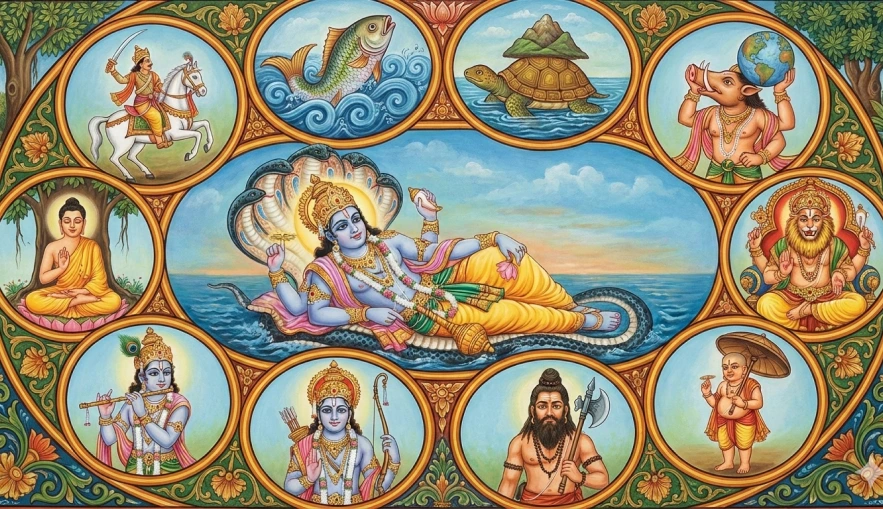
Dashavatara are the 10 avatars or incarnations, of Lord Vishnu who descends to earth to restore cosmic order, peace, and destroy evil influences. Dashavatara is derived from “Dash” referring to ten and “Avatar,” meaning incarnations. It symbolizes the various forms Lord Vishnu takes birth in various ages, or yugas, from “Matsya,” or fish, to the Kalki avatar in the future.
The various incarnations of Lord Vishnu represent the divine intervention of supreme energy to restore dharma and remove chaos in the universe. It is not only mythological beliefs but also linked with deep spiritual philosophy connected with Shaligram, a sacred fossilized ammonite stone. This blog explains what Dashavatara is and how it is related to the sacred Shaligram stone. The spiritual and philosophical importance of Dashavatara and the practice of Shaligram worship in Nepal are also explained.
What Is Dashavatara?
Lord Vishnu has 10 divine incarnations known as Dashavatara to ensure that the cosmic order is preserved across different ages or periods. Lord Vishnu has 10 incarnations in Hinduism, and the Kalki avatar is yet to form to save the world against negativity.
Depending on the cosmic age, the different forms of Lord Vishnu manifest in three forms that include animal form, human form, and divine form. Each avatar has a specific mission, which includes saving Earth, protecting devotees, destroying demons, and guiding humanity toward spiritual awakening.
The Dashavatara shows human development through time as it displays the process from basic aquatic existence to complete human understanding.
Order of Dashavatara Explained
| Avatar | Meaning | Purpose |
| 1. Matsya | First avatar taking the form of golden fish incarnation with human torso | Preservation of life and sacred knowledge, protection from negativity, beginning of new cosmic cycle |
| 2. Kurma | Second avatar as form of giant tortoise | To save universe, preserving balance during ocean churning (Samudra Manthan) |
| 3. Varaha | Third avatar manifesting as a boar | Rescue earth from the demon Hiranyaksha and establish dharma (Cosmic Order). |
| 4. Narasimha | Fourth incarnation in half-man and half-lion form | Protect devotees and destroy the evil demon Hiranyakashipu. |
| 5. Vamana | Fifth avatar as Dwarf Brahmin | Remove ego and restore balance in the universe. |
| 6. Parashurama | Sixth Immortal (Chiranjeevi) avatar as Brahman Warrior | To free the world from corrupt rulers, restore cosmic balance in the universe. |
| 7. Rama | Seventh avatar as Ideal Man (Maryada Purushottam) | Defeat Ravana and establish dharma |
| 8. Krishna | Eight avatars as divine teacher | Eliminate evil forces (kamsa), restore righteousness (dharma). |
| 9. Gautama Buddha | Ninth avatar represents a divine shift toward compassion, non-violence, and the rejection of extreme ritualism. | Promote peace, avoid violence, and guide humanity towards ethical living |
| 10. Kalki | Tenth and final incarnation of Lord Vishnu, who is yet to appear at the end of Kali Yuga. | End corrupt leader, end dark age of Kali, and restore purity in the universe |
Shaligram related with Dashavatara
Shaligrams or Shaligram Shila, are sacred fossilized ammonite shells that have high significance in Hinduism, being manifestations of lord Vishnu. The Shaligram stones are formed naturally, being ancient fossils ranging from millions of years old in smooth, dark, black, or golden shell appearance. These sacred stones also contain spiral markings, which represent the Sudarshan Chakra of lord Vishnu.
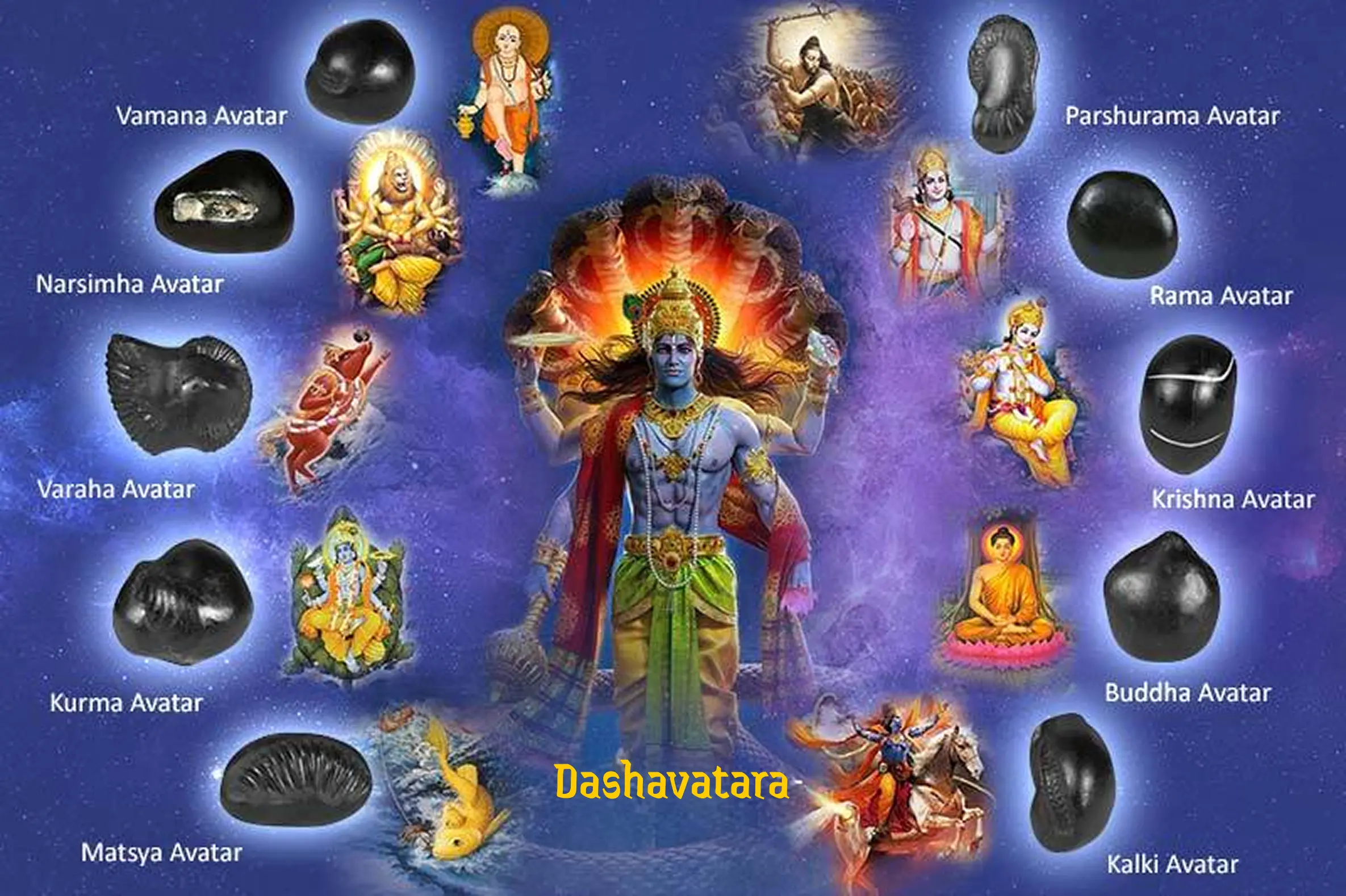
Saligram stones are found in Nepal’s Kaligandaki region, also known as Shaligramkshetra. The sacred stone is worshipped in temples and homes, as it is believed to promote prosperity, protection, and spread positivity. These stones often come in various shapes and are considered different forms of Vishnu’s incarnations. The Dashavatara is believed to be present in various types of forming natural shapes, markings, and patterns.
| Avatar | Associated Shaligram | Shaligram Features |
| Matsya | Matsya Shaligram | Fish-like shape |
| Kurma | Kurma Shaligram | Oval with dome shape resembling a turtle shell |
| Varaha | Varaha Saligram | Structure resembling boar |
| Narasimha | Narashimha Saligram | Wide opening, fierce chakra |
| Vamana | Vamana Shaligram | Small, round stone that might resemble footprint |
| Parashurama | Parashuram Shaligram | Hard texture, strong marks |
| Rama | Rama Shaligram | Smooth, balanced chakra representing divine nature of Rama |
| Krishna | Krishna Shaligram | Beautiful chakra, attractive form |
| Buddha | Buddha Shaligram | Simple, calm appearance |
| Kalki | Kalki Shaligram | Rare marking that resembles a horse’s mane. |
Spiritual and Philosophical Significance of Dashavatara
Dashavatara represents Vishnu’s divine incarnations for the protection of dharma, the restoration of cosmic order, and the guidance of devotees to spiritual awakening. The divine incarnation of Lord Vishnu is also worshiped as a form of Shaligram stone in Hinduism.
Protection of Dharma
Lord Vishnu takes incarnation to protect dharma (righteousness) to protect the universe from evil forces. Various forms and representations of incarnation are also worshiped as forms of Shaligrams. Dashavatar is a representation of life evolution and spiritual consciousness. The Matsya avatar symbolizes the origin of life and the preservation of knowledge whereas the Kurma avatar symbolizes stability and support. In the same manner, Varaha avatar is a symbol of elevating a soul out of ignorance and Krishna Shaligram is a symbol of love and wisdom.
Symbol of Spiritual Evolution
Dashavatar symbolizes the evolution of life and spiritual awareness. The Matsya avatar represents life’s origin and protection of knowledge, while the Kurma avatar represents stability and support. Similarly, the Varaha avatar represents uplifting the soul from ignorance, and the Krishna Shaligram symbolizes love and wisdom.
Inner Meaning for Devotees
Dashavatara is a divine character that eliminates evil energy, ignorance, and negativity. The avatars guide devotees to get rid of ignorance, anger, and worldly attachments. Worshipping Dashavatara as a form of Shaligram or using the sacred stone aids in purifying the mind and soul and creates a strong connection with lord Vishnu.
Conclusion
Dashavatara symbolizes 10 divine incarnations of lord Vishnu to save the universe and maintain cosmic order. All the avatars have profound spirituality and provide important life lessons. The different incarnations of Lord Vishnu are also worshipped in the form of Shaligram stones by Hindu followers in Nepal. Worshipping Shaligram is believed to provide blessings from lord Vishnu and its various incarnations. They are worshipped in temples and homes to get blessings and protection and to promote peace.
Dashavatara is still admired and is a source of faith and spiritual knowledge, telling us that divine power will never betray dharma and will show humanity the way to the truth. Visit Rudraksha Bhandar for purchasing various types of Shaligram Stone sourced from Nepal’s Kaligandaki or Shaligramkshetra at the best price in Nepal.
